
Low-fat taught consumers to distrust health claims built on compromise. Sugar could be next.
Brands have spent years taking sugar out. The harder question is whether they have put anything better in its place.
Seeing the similarities between the low-fat era of the 90s and today’s low-sugar era should make the food and drink industry uncomfortable. The once-dominant low-fat health promise became shorthand for bland taste, ultra-processed formulations and diet culture that reduced nutrition to a single villain. But consumers did not stop caring about fat. They just stopped believing that one missing nutrient made a product healthy.
Sugar reduction is moving toward the same breaking point that low-fat suffered. Low- and zero-sugar claims are proliferating just as shoppers are questioning ingredients, processing and simplistic wellness messages.
The next nutritional backlash is coming, and this time reduced sugar products will be the target. The low-fat era taught us that products most at risk are the ones that asked consumers to make compromises in taste, mouthfeel or enjoyment.
The core lesson is to move from less to better: products that protect taste while delivering benefits people can feel. For low sugar, this will mean steadier energy, digestive comfort, satiety and metabolic resilience. As definitions of “healthy” fragment, brands will need a portfolio of credible solutions rather than one universal low sugar answer.
What did the low-fat era teach us about nutrition claims?
Low fat became powerful because it turned a complex health debate into one simple instruction. Dietary guidance connected fat with heart disease and weight gain, and brands responded at scale. As revealed by GNPD nearly 11% of US food and drink launches carried a low/no/reduced-fat claim (client-access only) at its mid-2010s peak, compared with 3% today.
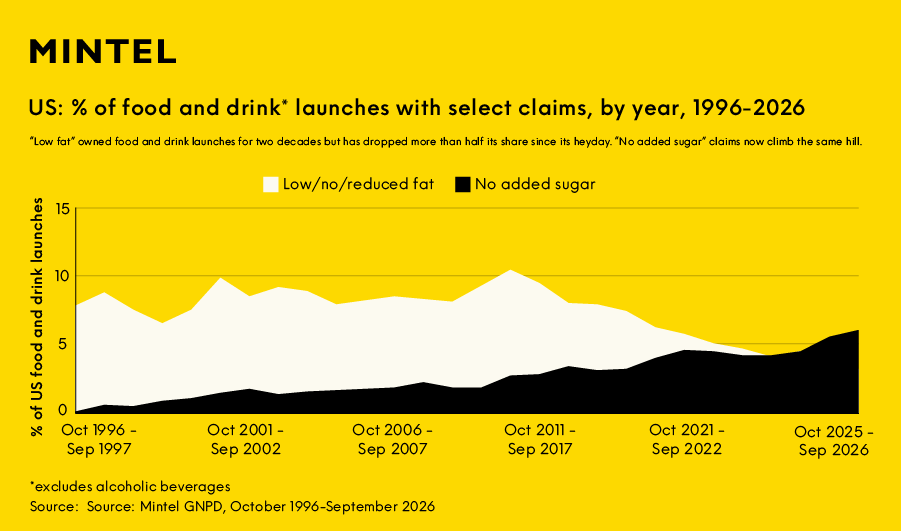
The concern about dietary fat did not disappear, but it lost its credibility as a healthy shortcut. Consumers learned that removing fat caused taste and satiety to suffer, as sugars, gums or starches took fat’s place. Nutrition science also distinguished between types of fat, and shoppers became more sceptical of highly processed diet foods.
Introducing the Nutrition Trend Cycle
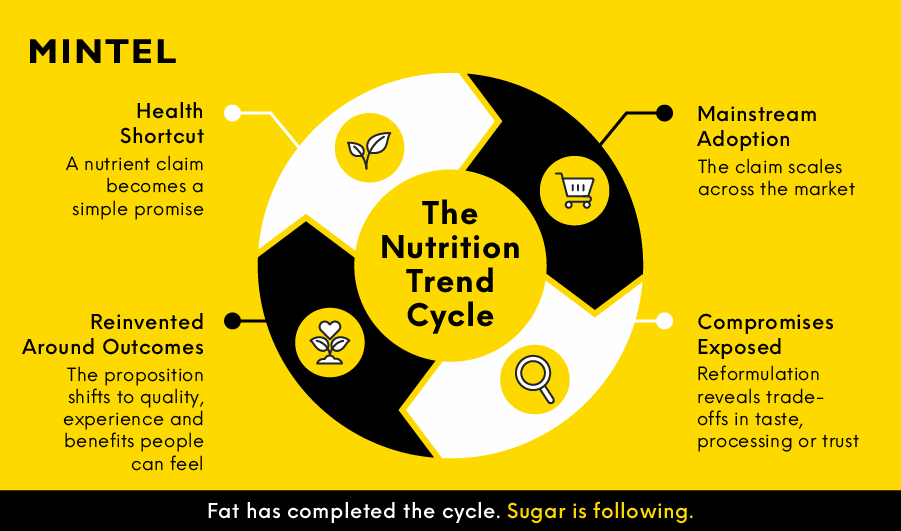
I propose a new theory for interpreting a recurring market pattern: the Nutrition Trend Cycle. A nutrient claim becomes a health shortcut, the claim reaches the mainstream, reformulation exposes new compromises, and the proposition is eventually reinvented around quality and outcomes. Viewed through this lens, fat has already completed this cycle. Now sugar is following a similar path.
The strategic lesson: simple claims mature into harder questions
Sweeteners have enabled brands to preserve indulgence while reducing sugar and calories. But today, challenging questions are emerging about taste, digestive tolerance, perceived artificiality, processing and long-term health. Allulose lawsuits and scrutiny of other sweeteners show how quickly a formulation solution can become a trust problem.
Perception can move faster than scientific consensus
The resurgence of beef tallow and avoidance of seed oils show that perceived authenticity can outweigh conventional guidance. While nutrition guidance continues to emphasize reducing saturated fat, tallow advocates view it as less processed and more traditional than industrially processed seed oils. Unrefined sugars, syrups and fruit-derived sweeteners may benefit from the same logic. The result is consumers can prefer an ingredient they understand over a substitute they distrust, even when the substitute offers a calorie advantage.
Healthy no longer has one definition
Consumers increasingly write their own nutritional rulebooks. Some prioritise metabolic health; others focus on ingredient simplicity, food sensitivities, processing levels or personal values. Around one in five younger US consumers make “free from” choices to align with their values, showing how identity and lifestyle now sit alongside nutrition guidance. Looking forward, evaluating foods through a single-nutrient lens will be too simplistic.
As definitions of healthy fragment, no single sweetness strategy will satisfy everyone. Traditional sugar in moderation, natural sweeteners, minimally processed syrups and zero-sugar options can all coexist, but only if each proposition clearly explains whom it serves and what benefit it delivers.
Will gut and metabolic health become the next test?
The low-fat era eventually prompted consumers to question whether added carbohydrates created a new problem. The low-sugar era may do the same for the sweeteners and additives used to replace sugar. Scrutiny could shift from sugar content to the formulation’s perceived effects on the gut microbiome, digestive tolerance and metabolic health.
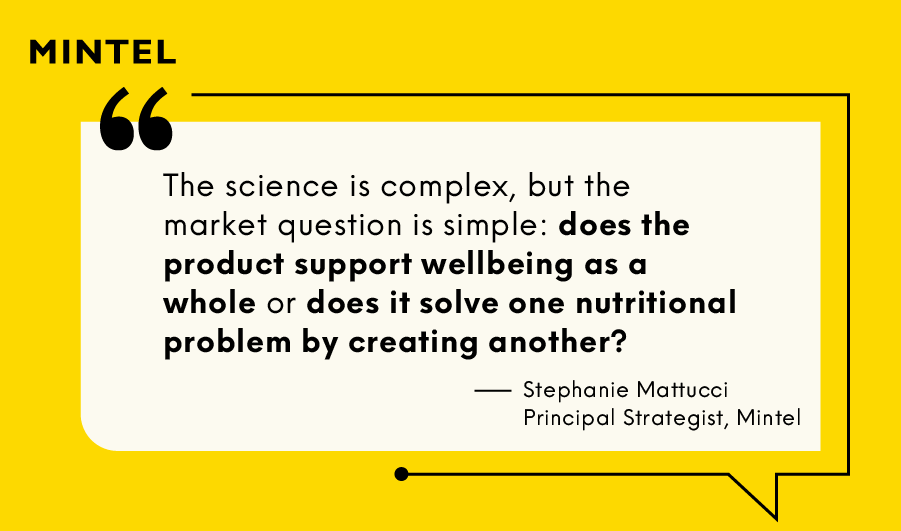
Gut dysbiosis, the disruption of the gut microbiome’s normal balance, offers a compelling consumer frame because it connects ingredients with experiences people recognise and even fear: bloating, discomfort, cravings and unstable energy. The science is complex, but the market question is simple: does the product support wellbeing as a whole or does it solve one nutritional problem by creating another?
Takeaway: sugar reduction still solves a real need, but a one-dimensional claim will not compensate for poor taste, discomfort or low ingredient trust.
The opportunity: design for metabolic resilience
Brands can start by evaluating sugar-reduction systems as complete biological, sensory and nutritional experiences. The stronger proposition combines less sugar with digestive comfort, stable energy, satiety and enjoyment, without overpromising what the formula can deliver.
Strategic direction: stress-test the whole sweetener-and-additive system for tolerance, taste and consumer trust, rather than optimising sugar grams in isolation. The winners will not simply remove sugar; they will make the replacement strategy credible, pleasurable and meaningful.
The brands that wait for backlash will inherit it
Low fat’s decline shows what happens when a successful health promise remains static while consumers become more sophisticated. Sugar reduction now faces the same test. “Less sugar” will remain relevant, but it will no longer be enough to establish that a product is healthy, desirable or meaningfully different.
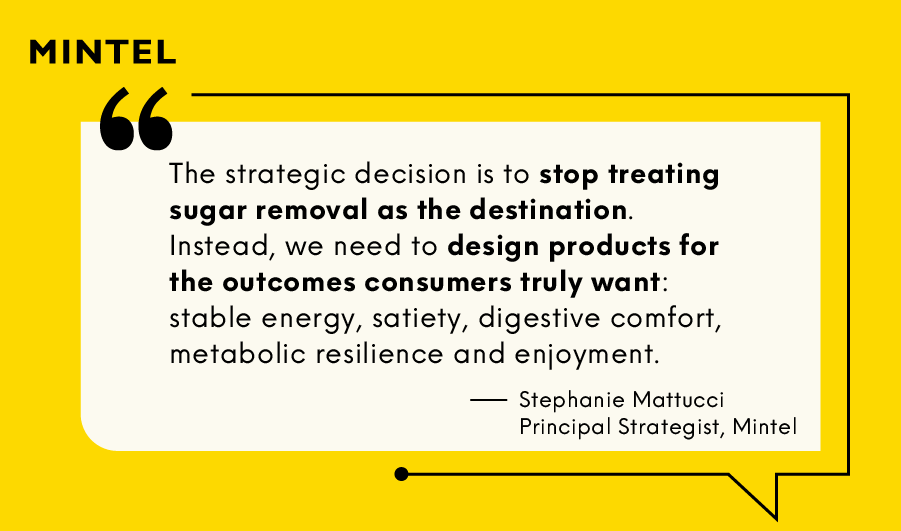
The strategic decision is to stop treating sugar removal as the destination. Instead, we need to design products for the outcomes consumers truly want: stable energy, satiety, digestive comfort, metabolic resilience and enjoyment.
Explore more about designing for outcomes and the Products to Systems framework by downloading our Global Predictions 2027 whitepaper.
There will never be one universal sweetness strategy. The winners will build a portfolio of credible answers. One product may use traditional sugar in moderation. Another may prioritise zero sugar. A third may use fruit-derived or minimally processed sweeteners. Each must state its benefit clearly and resist pretending to solve every health need at once.
Stephanie’s prediction for what the next decade of sugar holds and what brands should do
My prediction is that the next nutrition debate will move beyond sugar itself to the physiological and sensory consequences of replacing it. The brands that define “better” first will shape the conversation around positive outcomes rather than be forced to defend yesterday’s nutrition trend.
The opportunity is to lead sugar’s reinvention with products that make health benefits tangible without sacrificing pleasure. The cost of waiting is commoditisation, forced reformulation and weakened trust.
Innovation teams should act now: clarify the consumer outcome, stress-test the entire formulation and build distinct propositions for competing definitions of healthy.
As a strategic growth partner, Mintel can help brands anticipate where trust is shifting, identify the benefits that matter, and create a portfolio that makes “better” more powerful than “less.”
Want to explore what this means for your business? Stephanie is open to a conversation about the benefits that matter to consumers and the growth opportunities that matter to you. Get in touch via Stephanie’s bio.
Mintel clients can access the full Lessons From Low Fat for Sugar’s Next Decade report behind this article for deeper analysis, category data and strategic recommendations.
Interested in receiving insights into the trends redefining consumer behaviours and get the first look at the innovation worth watching? Stay in the know, with original thinking from our Thought Leaders by subscribing to Spotlight today.