
When every pack claims to be clinically proven, the claim alone won’t earn the shopper’s trust. Here’s what decides which proof gets seen, felt, and remembered.
Stand in front of a skincare or pharmacy fixture and the packs all speak the same language: dermatologist tested, clinically proven, percentages of actives, before-and-after promises. Shoppers have learned that language too. Mintel’s US research finds around three-quarters of consumers think beauty brands should provide more scientific evidence for their claims, and Mintel’s 2027 predictions see beauty brands competing for a bigger share of the routine, as spending stretches into supplements, devices and treatments, and brands need proof to earn their place.
Decoding what people see, feel and remember on pack is what we do at Dragonfly AI, and in these aisles, it points to a problem the category underestimates. On a crowded fixture, a pack carrying five credible claims can lose to one that makes a single cue impossible to miss.
Proof only builds trust if it’s seen.
Why can more proof mean less trust?
Dragonfly AI’s research points to three reasons:
- Every element competes for the same glance. Attention is captured automatically, before a shopper decides what to read. Seals, badges, percentages and ingredient call-outs all pull the eye in different directions, and when attention scatters, nothing lands. In one product image we analysed, making the product larger cut attention hotspots from eight to four and lifted Clarity – how focused attention is – from 45% to 83%.
- Background detail can drown the message. Simplifying a busy background in another example lifted attention on the product from 51% to 100%, and on the headline from 46% to 76%. Textures and imagery meant to signal science can bury the very claim they’re there to support.
- The fixture sets the rules. The influence of any visual cue depends on what’s around it. If every pack in the aisle borrows the same clean, clinical look, that look stops signalling anything. Packs need to be judged against the shelf they’ll sit on, not on their own.
What changes for healthcare packs?
In consumer health, regulation decides much of the hierarchy. MHRA guidance updated in July 2026 says critical information – the medicine’s name, strength, route, dosage, warnings and, for over-the-counter products, what it’s for – should sit together, be more prominent than anything else, and not be broken up by logos or graphics. Everything non-statutory must take second place.
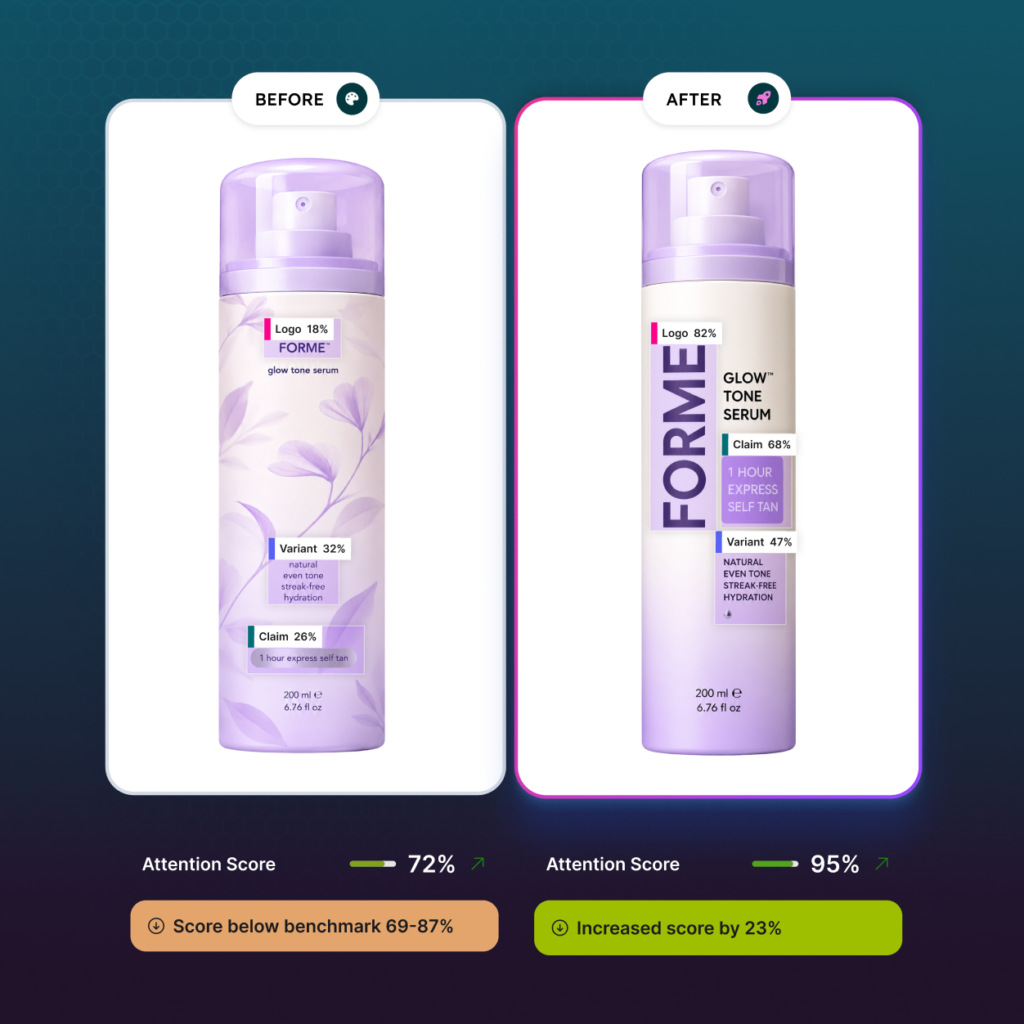
That’s the right priority for safety. It also means brand, benefit and reassurance must work in less space, with fewer tricks. The question moves from ‘what can we add?’ to ‘what will the eye find first, and in what order?’ That’s what Gaze Path analysis shows before a pack is printed.
Why does feeling matter as much as proof?
Mintel’s predictions also see beauty shifting “from clinical efficacy to experiential storytelling”. That fits what we measure. Emotion strengthens memory formation, so a pack that informs people without making them feel anything is easier to forget. The 42 creative characteristics behind our Memory and Emotion models include visual factors such as faces, facial expression intensity, visual clutter and white space – the same levers beauty and health brands use to signal care, calm or efficacy.
What does this mean for brands?
- Pick one proof point and give it room. The claim that matters most should be the easiest thing to find.
- Cut the clutter around it. Every extra badge competes for the same glance.
- In healthcare, design within the hierarchy. Then check what the eye actually finds first.
- Judge packs on the real fixture. Test next to the competitors they’ll sit beside.
- Measure feeling as well as visibility. A pack that’s seen but not felt is easily forgotten.
- Use the right tool for trust. Dragonfly AI shows whether a cue is seen, felt and remembered. Shopper research tells you whether it’s believed.
In categories built on credibility, the most trusted pack isn’t the one with the most proof. It’s the one whose proof gets seen.
See what shoppers notice first on your packs – explore our latest packaging insight on the Dragonfly AI blog.