Summary
Thailand’s new “Normal Sweetness = 50% Sweetness” standard for made‑to‑order drinks—officially launched on 11 February 2026—comes at a time when consumers are already leaning toward practical, flavour‑preserving sugar reduction per Mintel research. With the Department of Health resetting the default sweetness to half of current levels to curb rising NCD risks, brands now have a timely opportunity to align with a nationwide health push while meeting consumers’ preference for gradual, achievable changes.
New Mintel research shows that Thai consumers are becoming more mindful of their sugar intake. While 44% of consumers say they are trying to “strictly reduce” their sugar consumption, their day‑to‑day choices still reflect a practical, gradual approach rather than complete avoidance.
Data from Mintel Global New Products Database also points to a steady rise in reduced‑sugar innovation in Thailand. In 2025, categories showing an increasing share of launches among products with reduced‑sugar claims include nutritional meal replacements (12%), drinking yogurts (6%), and ready‑to‑drink (RTD) teas (4%).
People reduce sugar where it’s most noticeable
Consumers are most likely to cut back on sugar in categories where sweetness is highly visible. Sweets and desserts (67%) and RTD sugary drinks (61%) are the top categories they plan to reduce. By comparison, sugar found in everyday foods such as sauces and seasonings and dairy products is often viewed as functional or culturally ingrained, making it less likely to be reduced (33% and 24%, respectively). These categories are seen as part of routine eating rather than “added indulgence.”
Sweetness preferences vary widely across demographics
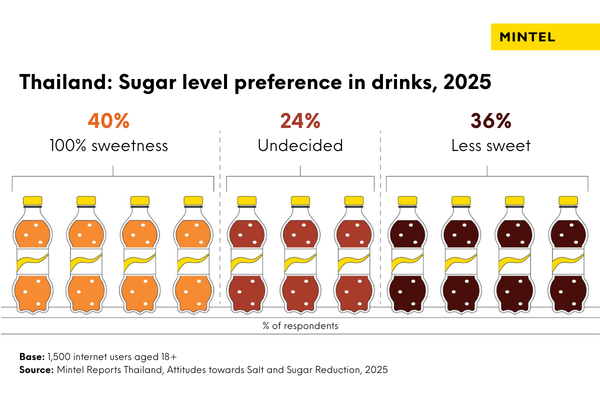
Taste remains an important factor in sugar reduction. While 40% of Thais prefer drinks at full sweetness, 36% favor less sweet options and 24% are undecided. Younger consumers, especially men aged 18-34, tend to prefer full sweetness, while women aged over 55 are more inclined toward lower-sugar drinks. Even among consumers who report trying to “strictly reduce” their sugar intake, preferences are not absolute: 18% strongly prefer 100% sweetness, while 17% disagree with that sentiment. This highlights that sweetness tolerance is shaped by context or occasion rather than a fixed rule.
Nearly two‑thirds of Thai consumers say they are willing to pay more for reduced‑sugar drinks. Fewer than half would pay extra to keep the original sweetness despite the ongoing sugar tax in Thailand. Mintel research suggests that many now see reduced sugar as an added value, while original taste is simply expected, not an extra feature worth paying more for.
“Consumers respond most positively to simple, progress‑oriented claims such as “low sugar” or “reduced sugar.” These messages feel practical and achievable. More technical or absolute claims including “sugar‑free,” “fibre‑sweetened,” or “low GI” may feel either too strict or too complicated for everyday decision‑making,” said Phurisa Phagudom, Food and Drink Analyst, Mintel Reports Thailand.
“While claims like “sugar‑free” and “no added sugar” remain common in the market, brands may find more success leading with simpler reduction‑based claims for mainstream audiences and positioning technical claims where they are more relevant to specific segments.”
Caution remains around sugar substitutes
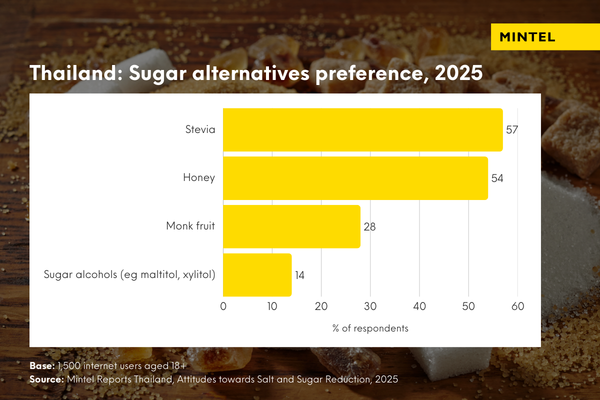
Only 27% of consumers say they are willing to switch to salt or sugar substitutes. Familiar options such as stevia and honey remain the most preferred, while newer sweeteners, such as monk fruit and sugar alcohols (e.g. maltitol, xylitol), tend to be viewed as more technical or unfamiliar.
There is also a growing interest in using nutrients as sugar alternatives: About one in four consumers is open to replacing sugar with other forms of nutrition, with fibre and protein emerging as the most appealing options. However, according to Phagudom, clearer education may help consumers better understand how these ingredients can support healthier diets.
“Overall, the findings suggest that Thai consumers are not looking for drastic change. Instead, they are seeking balanced products that support gradual improvement without sacrificing flavor,” she added.